
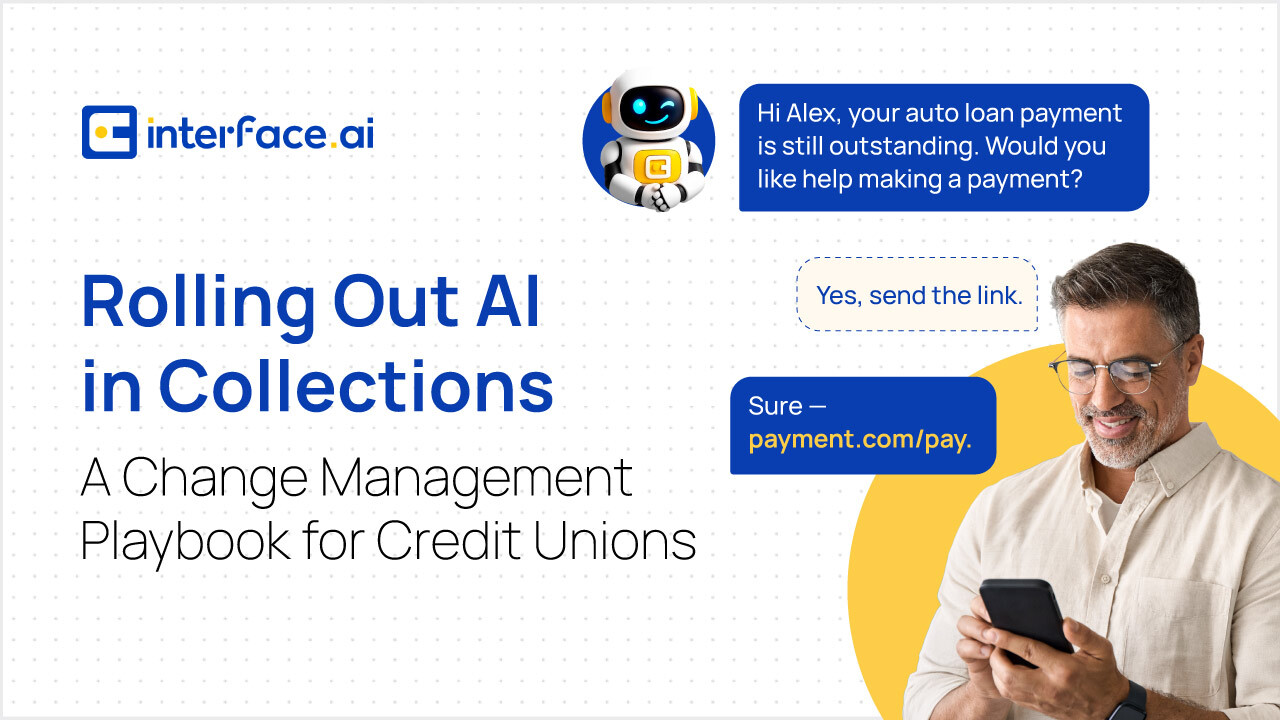
Rolling Out AI in Collections: A Change Management Playbook for Credit Unions

Collections leaders at credit unions face a constant tension: you need to engage delinquent members earlier – when cures are still likely – but every outreach attempt carries reputational and regulatory risk.
At the same time, pressure is rising. Credit unions reported 95 basis points total delinquency in Q3 2025, while collections teams remain understaffed and member expectations continue to grow.
That’s why AI-powered collections technology is both promising and intimidating. When an AI system can make real-time decisions inside a collections journey, the stakes are higher than traditional outbound dialing or one-way notification tools.
A new model is emerging: agentic collections AI. In practice, agentic means the AI can make limited, policy-bounded decisions within a workflow – such as selecting the right channel, responding to member intent, or escalating to a human when risk signals appear.
Platforms like Agentic Smart Collections AI from interface.ai coordinate voice, SMS, and email outreach while enforcing policy guardrails across every interaction.
This post outlines a change-management playbook for rolling out AI in collections safely.
Why AI in collections requires more governance
Traditional collections tools treat communication channels separately: calls in one system, texts in another, and emails somewhere else entirely.
Members don’t experience it that way. They experience one institution reaching out—sometimes too often, sometimes at the wrong time, and sometimes with inconsistent messaging.
Modern AI-powered collections platforms coordinate outreach across channels through specialized agents:
- Voice AI places outbound calls, verifies member identity, captures Promise-to-Pay commitments, and escalates to human agents when necessary.
- Two-way SMS AI manages inbound and outbound conversations, handles STOP/opt-out compliance, and delivers secure payment links.
- Two-way Email AI uses compliant templates and processes replies to keep conversations moving forward.
When these channels operate as a coordinated journey, the rollout conversation changes. Instead of asking “Does the script work?”, leaders need to ask: “Do our policies, escalation paths, and QA controls keep the system inside the lines?”
What agentic collections looks like in practice
Consider an early-stage delinquency scenario for an auto loan:
- Day 3 past due: the system sends an SMS reminder with a payment link.
- Day 7: if payment hasn’t been made, an outbound voice call is attempted.
- Member response: if the member replies “I lost my job,” the system detects a hardship signal and escalates the case to a human collections specialist.
- Follow-up: the specialist receives conversation history and context, allowing them to respond appropriately.
This kind of orchestration allows institutions to engage earlier while ensuring sensitive situations receive human attention when needed.
The guardrails that keep AI collections safe
Agentic collections systems are only as safe as the guardrails around them. For financial institutions, that means ensuring automation operates within clearly defined policies.
Key safeguards include:
Contact governance
Define contact frequency caps, quiet hours, and channel preferences so outreach stays compliant with regulatory expectations.
Identity and data protection
Require identity verification before discussing account details on voice channels, and carefully define what information can be shared through SMS or email.
Human escalation paths
Establish clear triggers for escalation – such as hardship signals, disputes, complaints, or wrong numbers – and define who handles those cases.
Approved templates and tone controls
Use compliant templates tailored by loan type and delinquency stage, with guidelines that ensure outreach remains professional and member-focused.
Automated QA and audit readiness
Log every interaction and use automated QA scoring to monitor compliance, tone, and conversation quality.
Together, these guardrails ensure AI operates as part of a governed collections workflow, not as uncontrolled automation.
A safe rollout approach
Rolling out AI in collections works best when institutions start small and expand gradually.
1. Design (1–2 weeks)
Choose a narrow pilot—such as one loan type and one delinquency segment—and define policies, templates, and escalation rules.
2. Simulate (several days)
Run internal scenarios such as opt-outs, hardship signals, disputes, and wrong numbers to validate that policies and routing behave as expected.
3. Pilot (2–4 weeks)
Launch the system with a limited population and conduct daily QA reviews. Treat the pilot as an operational test rather than a full-scale launch.
4. Scale gradually
Expand to additional loan types and delinquency stages only after QA scores stabilize and escalation workflows operate smoothly.
This phased approach helps collections teams build confidence while minimizing operational risk.
Wrap-up
Successful AI in collections isn’t about automating more – it’s about automating safely.
Agentic Smart Collections AI from interface.ai helps credit unions coordinate voice, SMS, and email outreach with policy guardrails, human escalation, and automated QA built in.
That means earlier engagement, better member experiences, and collections programs that scale with confidence.

AI Insights for Credit Union & Community Bank Leaders
Join the monthly newsletter for all the latest industry updates
The Difference Between AI that Answers and AI that Acts – and Why it Matters for Credit Unions
Paid
Members
Public
A member calls to move money between accounts. Your AI answers. It tells her the balance. It confirms that yes, transfers are something the credit union offers. It suggests she log into online…
How Agentic AI is Moving the Efficiency Ratio for Credit Unions
Paid
Members
Public
In a CUInsight webinar featuring Navigator Credit Union and Red Rocks Credit Union, the conversation focused on what AI in the contact center looks like in production—not in pilots or theory, but at…