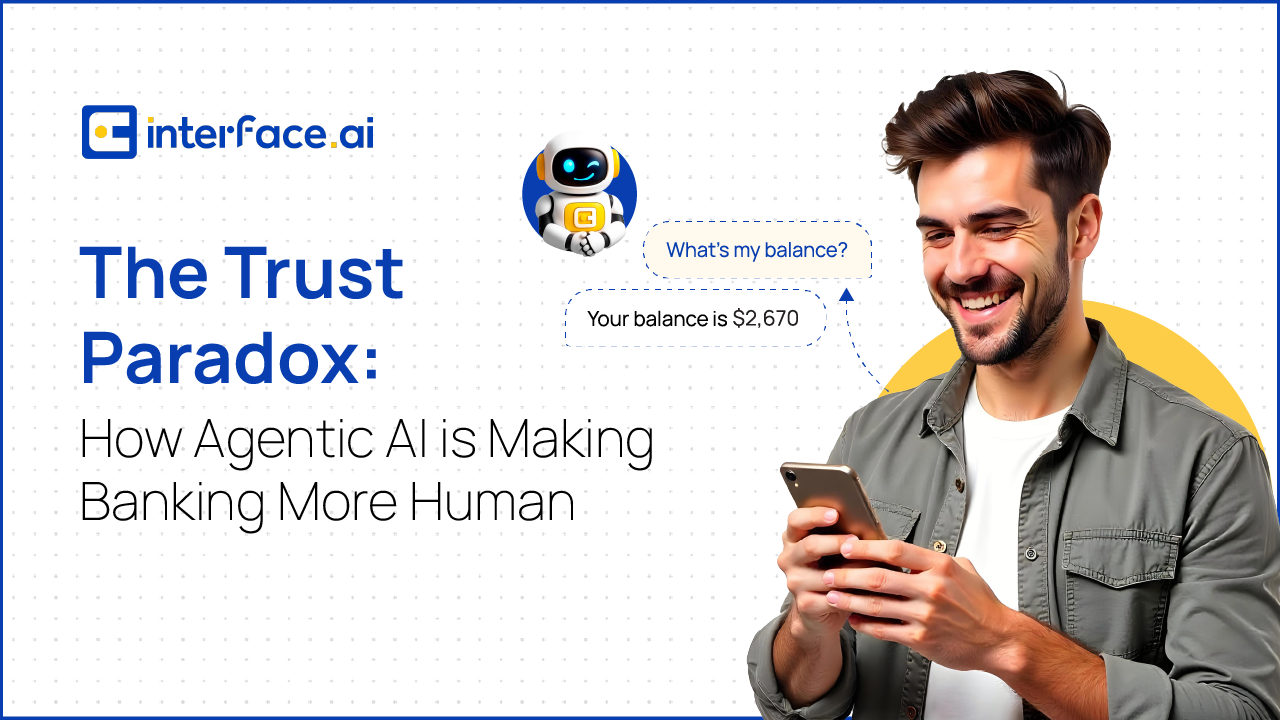
The Trust Paradox: How Agentic AI is Making Banking More Human

Kate Rogerson

For years, people were right to be skeptical about AI in banking. Early automation was rigid, scripted, and anything but personal. It did make service feel less human.

But 2026 is a different world – especially with agentic AI.

Today’s agentic AI is capable, conversational, and context-aware. It resolves tasks end-to-end and knows exactly when to bring a human into the loop. Which brings us to the new reality:

You no longer have to choose between AI and human service – agentic AI actually makes banking more human. And right now, the problem isn’t that AI is “too cold” or “too impersonal.” The problem is that without AI, members can’t reach the humans they trust when it matters.

The 2026 myth: AI replaces relationships

For years, the industry has treated AI and humanity as opposites – automation versus empathy, efficiency versus relationships. That tension made sense when AI was limited to scripts and rigid decision trees.

But agentic AI changes the equation.

Agentic AI doesn’t replace relationships. It removes the friction that prevents relationships from happening.It:

  • Handles the repetitive questions that clog phone lines
  • Guides members through multi-step tasks automatically
  • Takes action across systems without human intervention
  • Escalates instantly when a human touch is required

The result? Staff finally have the time and space to be human again. The old model forced agents to be switchboards. The new model – powered by agentic AI – frees them to be advisors, guides, and relationship builders.

The human impact: What agentic AI did at Navigator Credit Union

Navigator Credit Union shows exactly how agentic AI can transform a contact center without losing the human touch.

Before implementing interface.ai’s agentic Voice AI, their team spent an enormous amount of time answering the same routine questions – balance inquiries, routing details, basic account tasks, password resets. These calls were essential, but they pulled staff away from the conversations where members genuinely needed guidance, empathy, or deeper support.

Agentic AI changed that dynamic almost immediately. Navigator’s Voice AI (referred to by their team as “V6” in the video below) now handles the bulk of common queries with impressive accuracy and consistency. It understands intent, completes tasks end-to-end, and resolves issues that previously tied up agents.

With those routine calls off their plates, Navigator’s agents finally have the capacity to focus on the interactions that require human judgment: fraud concerns, loan discussions, financial guidance, and moments where members simply need someone to talk to. The shift hasn’t just improved efficiency; it’s improved the quality of the human conversations that matter most.

“Instead of repeating the same answers over and over, our team now has the time to help the members who really need us.” – Krystal Brown, Senior Director of Technology Information at Navigator Credit Union

The real drivers of trust in an agentic AI world

Trust in banking has never come from technology alone.
It comes from responsiveness, clarity, reliability, and human presence.

Agentic AI strengthens all of these:

  • Responsiveness: Members get answers immediately – 24/7.
  • Clarity: AI can explain steps, policies, and actions in natural language.
  • Reliability: It never forgets, misroutes, or loses context.
  • Human presence: It escalates at the right moment, not the last moment.

When agentic AI handles the routine, humans are finally free to handle the meaningful.

Learn more about what agentic AI really is, what makes it so different to previous AI systems, and how it can be used to improve service and support for credit unions and community banking.

AI Banking Voice AI