
Beyond the Link: Why Multi-Granular Retrieval is the Future of Member Service

In today’s market, your Voice AI and chatbot systems are the frontline of your member experience. A modern member expects a precise, contextual answer in seconds, not a link to a generic webpage.
When a member calls to ask for a loan rate and your AI responds, “I will send you a link to our car loan rate page,” that’s not automation – it’s digital deflection. It’s the moment your member feels the frustration of dealing with a machine, and it’s where we differentiate our approach.
The solution isn’t simply a better chatbot; it’s a fundamental shift in how the AI retrieves and processes your vital knowledge. We call this approach Multi-Granular Retrieval.
The Competition’s Problem: Single-Granularity Retrieval
Most AI systems in the market rely on a concept called Single-Granularity Retrieval.
Imagine your complete 20-page document of loan rates, terms, and requirements. The competition’s AI breaks this document into uniform, medium-sized chunks (e.g., 500 words each).
When a member asks, “What is the car loan rate?”
- The AI retrieves a large, dense chunk of text that contains all rates for new cars, used cars, various terms, and different credit scores.
- The Result? The AI receives too much information (“noise”) without the specific context it needs. Because it cannot synthesize a responsible answer (it needs to know the member’s credit score first), it defaults to the pre-programmed safety net: “Here is the link.”
- The Cost: Increased frustration, a lost moment for cross-selling, and a higher chance the member will hang up and call a human agent or, worse, a competitor.
Our Solution: Multi-Granular Retrieval (MGR)
Our approach, Multi-Granular Retrieval (MGR), is designed to mimic how your most experienced loan officer thinks, ensuring the AI is precise and proactive in its response.
MGR indexes your knowledge base at three levels of detail, allowing the AI to retrieve multiple, relevant pieces of information simultaneously:
| Granularity Level | Information Retrieved | Role in the Answer |
| 1. Fine-Grained (Small) | The specific fact (e.g., 5.99% is the lowest rate.) | Provides Precision—the exact number. |
| 2. Medium-Grained (Context) | The prerequisite criteria (e.g., Requires a 740+ FICO score for 5.99%.) | Provides Proactivity—the necessary context. |
| 3. Coarse-Grained (Global) | The document metadata (e.g., These rates were updated this morning.) | Provides Confidence—ensures data is current and compliant. |
The MGR Advantage: A Human-Quality Response
When a member asks, “What is the car loan rate?” with MGR, the system executes an Adaptive Fusion:
- It retrieves the precise, lowest rate (5.99%) from the Fine-Grained index.
- It retrieves the critical pre-qualification criteria (740+ FICO score) from the Medium-Grained index.
- It confirms the rates are current from the Coarse-Grained index.
The result is a complete, contextual, and confident answer:
“Our new car loan rate starts at 5.99% for a 36-month term. Please note, this preferred rate is reserved for our Tier 1 credit members, which typically requires a FICO score of 740 or higher. Do you know what your credit tier is, or would you like to hear about our other loan terms?”
This is not a deflection; it’s an intelligent, sales-driven interaction that guides the member instantly to the next step.
MGR is an Investment in Member Experience
For Credit Unions and Community Banks, Multi-Granular Retrieval translates directly into business value:
| Single-Granularity (Competition) | Multi-Granular Retrieval (Our Approach) |
| Deflection | Resolution |
| Increased Call Center Volume | Reduced Agent Hand-Offs and operational cost |
| Slow, generic answer | Fast, personalized answer |
| Member Frustration (low CX score) | Proactive Engagement (high CX score) |
By implementing Multi-Granular Retrieval, you equip your AI with the intelligence to handle the complexity of financial products, transforming an average digital experience into a competitive advantage for your institution.
Evaluating AIs for proof of MGR implementation
To evaluate whether a Voice AI system is using Multi-Granular Retrieval (MGR) or a simpler, standard retrieval system, you can ask specific “test” questions.
These questions work because they require the AI to do two things at once: grab a specific fact (fine-grained) and understand the surrounding context or conditions (coarse/medium-grained). A standard system will likely fail these checks and default to sending a link.
Here is a list of questions a caller can ask to test the system:
1. The “Ambiguous Variable” Test
Does the AI give me the ‘best’ answer with context, or does it give up because there are too many variables?
- Question: “What is the lowest rate you have for a car loan right now?”
- Non-MGR (Standard): “Rates vary by term and credit. I’ll send you a link to our rates page.”
- MGR (Success): “Our lowest rate is 5.99%. That requires Tier 1 credit and a 36-month term. Would you like to hear rates for longer terms?”
- Question: “What’s the interest rate on a savings account?”
- Non-MGR (Standard): “We have several savings products. Please check our website for current yields.”
- MGR (Success): “Our standard savings rate is 0.50% APY, but our High-Yield Money Market account currently pays 4.25% APY if you maintain a balance over $2,500.”
2. The “Needle in a Haystack” Test
Can the AI find a tiny, specific detail buried in a large policy document?
- Question: “Do I get a discount on my loan if I set up autopay?”
- Non-MGR (Standard): “Here is a link to our loan benefits page.” (It misses the footnote detail).
- MGR (Success): “Yes, we offer a 0.25% rate discount if you enroll in automatic payments from your checking account.”
- Question: “Is there a penalty if I pay off my mortgage early?”
- Non-MGR (Standard): “I’ll send you our mortgage disclosure document.”
- MGR (Success): “No, our mortgages have zero prepayment penalties. You can pay off your loan early at any time without fees.”
3. The “Process & Prerequisites” Test
Can the AI summarize a process (coarse) while listing specific required items (fine)?
- Question: “What documents do I need to bring to open a business account?”
- Non-MGR (Standard): “You will need proper documentation. I’ll text you a checklist.”
- MGR (Success): “You will need your EIN (Tax ID), your Articles of Incorporation, and a valid government ID for all signers.”
- Question: “How does your overdraft protection work if I don’t have a savings account?”
- Non-MGR (Standard): “We have overdraft options. I’ll send you a link to our fee schedule.”
- MGR (Success): “If you don’t have a linked savings account, you can apply for an Overdraft Line of Credit. It covers transactions up to a set limit, and you only pay interest on what you use.”
4. The “Freshness” Test
Does the AI understand metadata (dates) associated with the document?
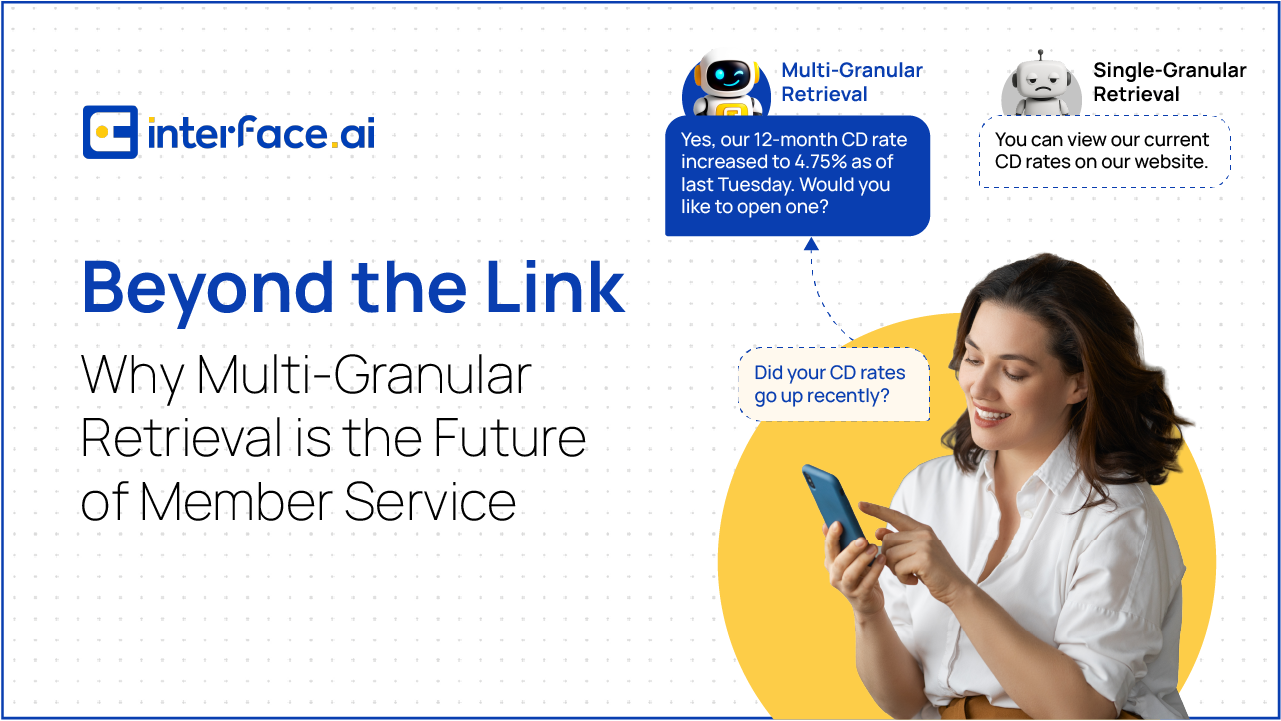
- Question: “Did your CD rates go up recently?”
- Non-MGR (Standard): “You can view our current CD rates on our website.”
- MGR (Success): “Yes, our 12-month CD rate increased to 4.75% as of last Tuesday. Would you like to open one?”
The “Red Flag” Responses (Signs it is NOT MGR)
If you ask these questions and hear any of the following, the system is likely using the inferior approach:
- “It depends…” followed immediately by an offer to send a link.
- “I can’t give you that specific number over the phone…”
- “Please visit our website for the full details.”
- The AI reads a long, generic paragraph that lists every possible option (New, Used, Boat, RV) without answering your specific question about a “car.”

AI Insights for Credit Union & Community Bank Leaders
Join the monthly newsletter for all the latest industry updates
The Difference Between AI that Answers and AI that Acts – and Why it Matters for Credit Unions
Paid
Members
Public
A member calls to move money between accounts. Your AI answers. It tells her the balance. It confirms that yes, transfers are something the credit union offers. It suggests she log into online…

How Agentic AI is Moving the Efficiency Ratio for Credit Unions
Paid
Members
Public
In a CUInsight webinar featuring Navigator Credit Union and Red Rocks Credit Union, the conversation focused on what AI in the contact center looks like in production—not in pilots or theory, but at…